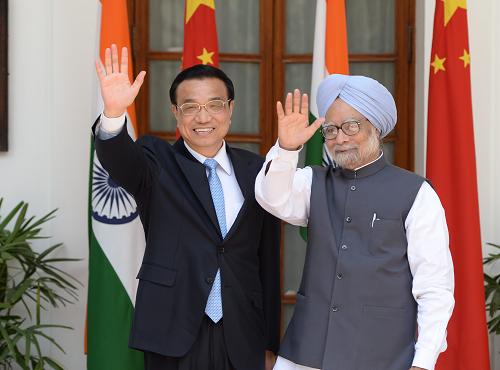
On May 20, 2013, Premier Li Keqiang of the State Council held in-depth and practical talks with Indian Prime Minister Manmohan Singh in New Delhi, reaching broad consensus and agreeing to further strengthen China-India strategic cooperative partnership for peace and prosperity and to push for new achievements of bilateral cooperation.
Li Keqiang said that China and India are important close neighbours and partners by nature for each other. The two countries have in recent years made remarkable progress in the bilateral relations, with deepening political mutual trust, fruitful cooperation in all fields, and expanding people-to-people exchanges. China and India have enjoyed sound coordination and cooperation on major regional and international issues, and made positive progress on border negotiations. China is glad for the achievements in bilateral relationship and fully confident for the future.
Li Keqiang said, India is the first stop of my first visit abroad as the Chinese Premier after taking office. It fully demonstrates that the new Chinese government attaches great importance to develop China-India relations as well as its sincere aspiration. China is willing to join the efforts with India to seize the opportunities, to deepen cooperation, and to benefit the two peoples from the development of the China-India relations.
First, China and India need to strengthen strategic communication and to enhance political mutual trust. The leading role of the regular high-level visits and meetings between leaders of the two countries for the bilateral relations should be in full display. The consultation and communication mechanism between the governments, parties and parliaments of the two countries should be of full use for deepening strategic dialogue and maintaining exchanges at all levels.
Second, to promote practical cooperation and to deepen the convergence of each other's interests. To promote liberalization, facilitation and dynamic balance of the bilateral trade, to expand two-way investments, to start bilateral negotiations on regional trade arrangements, to carry out cooperation on major projects in the fields of industrial parks and infrastructure, to advocate together for building up an economic corridor among Bangladesh, China, India and Myanmar and to push for closer links between the two major markets of China and India.
Third, to strengthen cooperation in national defence, to enhance mutual trust on security affairs. To strengthen military exchanges by carrying out consultations in the fields of defense and security and by conducting joint training and drills. To keep strategic communication on maritime affairs and join hands for safeguarding peace and security.
Fourth, to expand cultural and people-to-people exchanges and to enhance mutual understanding. To designate the year 2014 as the “Year of China-India Friendly Exchanges” and to commemorate the 60th anniversary of the launch of the Five Principles of Peaceful Coexistence. To expand exchanges and cooperation on education, to promote communication between the media, to continue the exchange of visits between the youth, and to push forward local exchanges.
Fifth, to take into account each other's concerns and properly handle sensitive issues. To strengthen communication and consultation on border issues, to enhance the efficiency of the existing mechanisms, and to maintain peace and tranquility along the borders before reaching a solution acceptable to both sides. To make full use of the existing mechanisms to beef up cooperation on issues concerning cross-border rivers.
On behalf of the Indian government and the people, Singh warmly welcomed Li Keqiang for his visit. He said that India and China, both at a crucial stage of development, share extensive common interests and harbor great potential for cooperation. India and China will always be best neighbours and cooperative partners no matter how situations change in the region and in the world. Premier Li Keqiang’s visit is of milestone significance and will surely push for greater development in the India-China strategic cooperative partnership. Singh fully agreed with Li Keqiang’s comments on India-China relations as well as his proposals on further developing bilateral relationss, expressing willingness to work with the Chinese side to actively implement consensus reached by the two sides and to help achieve more fruitful results in bilateral cooperation in all fields.
Li Keqiang reiterated the principle position of the Chinese government on Tibet. Singh said that the Indian government recognizes the Tibetan Autonomous Region (TAR) as part of the Chinese territory and never allows any force to conduct anti-China activities on the Indian soil.
The both sides also had an in-depth exchange of views on international and regional issues of common concern, agreeing to enhance coordination and cooperation within the G20, BRICS and other mechanisms and to boost cooperation on the issues of climate change, anti-terrorism and food and energy security, so as to increase the say of developing countries and safeguard common interests.
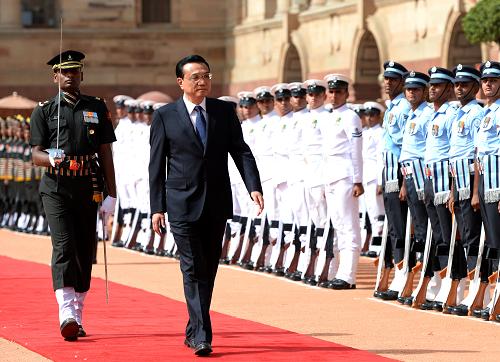
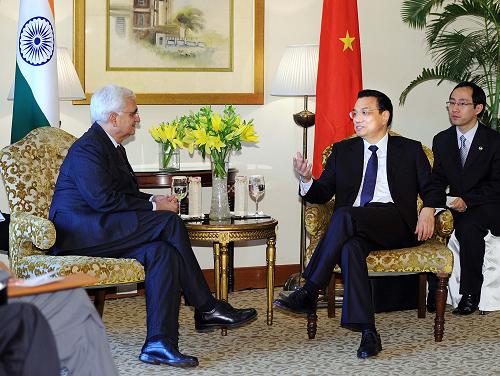
Prior to the talks, Li Keqiang attended a welcome ceremony held by Prime Minister Singh and had a courtesy meeting with Indian Foreign Minister Salman Khurshid.
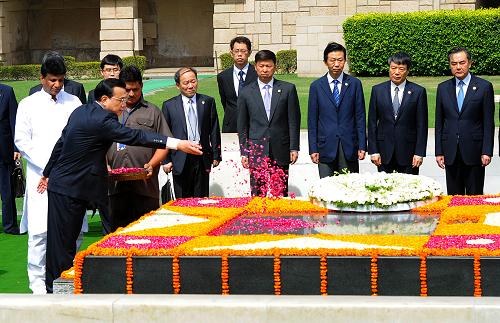
Li Keqiang laid a wreath at the Tomb of Gandhi the same day.