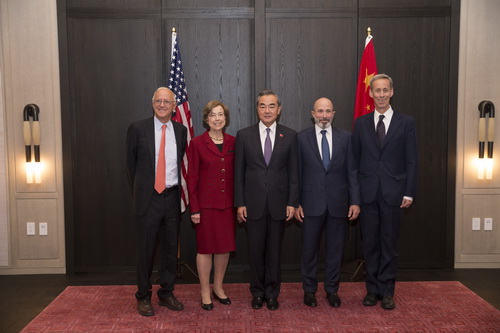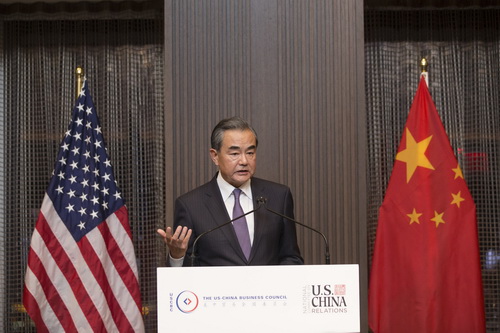
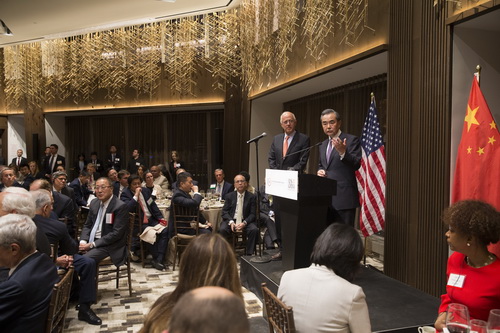
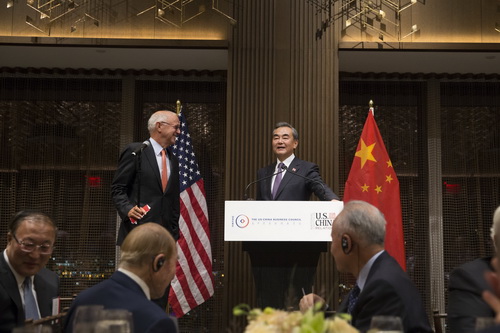
On September 24, 2019 local time, State Councilor and Foreign Minister Wang Yi attended a dinner co-hosted by National Committee on United States (US)-China Relations, US-China Business Council, US Chamber of Commerce and Council on Foreign Relations in New York, the US, and delivered a keynote speech titled "Vision and Conviction Will Take China-US Relations Forward".
Wang Yi expressed, this year marks the 40th anniversary of China-US diplomatic relations. Over the past four decades, China-US relations have weathered many twists and turns. Yet they have steadily moved forward with progress beyond even people's boldest imagination. Currently, China-US relations have once again come to a crossroads. Where will China-US relations go in the next 40 years? When we assess and decide on such a momentous issue, we must turn to history and look at the past four decades of China-US relations for inspiration and guidance.
First, mutually beneficial cooperation is the only right option for China and the United States, and neither country has taken advantage of the other. Both countries have benefited tremendously from cooperation in the past 40 years. Such cooperation, enhanced by our comparative strengths, has helped drive robust growth of the US economy, substantially cut the cost of living for US families, and enabled American firms to take home huge profits. The trade frictions between China and the US in the past year and more have inflicted losses on both countries, losses that shouldn't have happened. Higher tariffs have raised the production cost of US companies, pushed up US consumer prices, and dampened the growth prospects of the US economy. Businesses, farmers and consumers of the United States have felt mounting pressures. All this points to one simple fact: Cooperation benefits both China and the United States and the rest of the world; friction will only create a lose-lose situation and harm the whole world.
Second, opening-up and integration represents the right direction, and neither China nor the United States can move ahead without the other. China and the US are now the most important trade partners and investment destinations for each other. Our industrial, supply and value chains are deeply interconnected, and our interests closely entwined. Given the size of our economies and the level of interdependence, the so-called "decoupling" or "shutting the door to each other" is just like an attempt to build castles in the air. It is neither sensible nor realistic. The Chinese economy has grown from a small pond to something as big as a vast ocean. It has the world's biggest and most promising market with the largest and fastest-growing middle-income population. Decoupling from the Chinese economy would be decoupling from opportunities, and from the future. While China opens wider to the US and the rest of the world, we expect the US to do the same to China and remove all unreasonable restrictions.
Third, conflict and confrontation will lead nowhere, and neither country can mold the other in one's own image. China and the United States differ from each other in history, culture, social system, development path and national conditions. Disagreements and frictions between us are almost inevitable. What matters most is that we perceive them objectively and handle them properly. Differences and disparities should not be a chasm preventing people from engaging each other. Rather, they could become an impetus for mutual learning and shared progress. The US side's idea of molding others according to one's wish is wrong, and will never work. Lessons of the history are worthy of learning. The US should not start another wrong fight with the wrong country.
Seventy years of history leads to the conclusion that the path of socialism with Chinese characteristics is a right path and is hence fully and firmly supported by the Chinese people. Which other system on earth could ensure unity and stability of a country as enormous and sophisticated as China and make it an important pillar for world peace and security? Which other path could China take to create a miracle of development, lifting 1.4 billion people out of poverty and delivering moderate prosperity in all respects, and, while at it, making such a major contribution to human progress? As an ancient civilization with 5,000 years of history, China will not be blinded by floating clouds. We will maintain our strategic focus and our confidence in our culture. We will not be influenced, and even less manipulated. We will unswervingly follow the path and direction we have chosen. We will always grasp the future of our country and nation in our own hands and march toward the great renewal of the Chinese nation with an indomitable will.
It is never China's intention to change the United States. Likewise, the United States should not seek to change China. Both countries have their own development goals, which are not mutually exclusive or a zero-sum equation. We may well help each other and work with each other. The key is to embrace an open mind and respect each other's right to development, and appreciate each other's accomplishments. We must find a way for two major countries different in social system and cultural background to live together on this planet in peace and to cooperate with each other for win-win results.
Fourth, shouldering responsibilities together accords with the trend of history, and neither of our two countries has to replace the other. Some in the United States worry that China will unseat the United States from its role in the world. This is a strategic misjudgment about China and shows a lack of self-confidence. China is still the largest developing country in the world. Traditional Chinese culture stresses moderation and humility. Seeking hegemony has never been in the Chinese DNA. China has no intention to play the "game of thrones" on the world stage. We are glad to see that the United States will continue to play a constructive role for global peace and development. The world is confronted with growing global challenges. No country can do well in isolation or fix all the problems by itself. Sharing international responsibilities is an inevitable trend. All countries, especially the big ones, can complement one another by drawing on their strengths. China stands ready to fulfill its due responsibilities.
Wang Yi said, the two Presidents have agreed that our two countries need to manage differences on the basis of mutual respect, expand cooperation on the basis of equality and mutual benefit, and jointly advance the China-US relations based on coordination, cooperation and stability. How to effectively implement what our Presidents have agreed upon? I wish to share with you three observations.
First, for areas where we can cooperate, we need to resolutely advance and deepen such cooperation in a win-win spirit. Under the current circumstances, there are more and more areas where China and the US can and should cooperate. All require that our two countries engage in focused and deeper cooperation to benefit our peoples and beyond, and to lend new impetus to the growth of our relations in the new era.
Second, for issues where we do not see eye to eye with each other, we need to have them properly managed in the spirit of avoiding conflict or confrontation. We must not let our mind be controlled by prejudice and apprehension, or let our relationship be defined by conflict and confrontation. What we need is to keep working to expand common ground while setting aside and reducing differences. China's Belt and Road Initiative is not targeted at the United States. What we don't welcome are attempts to discredit the initiative. Some cooperation proposals put forward by the US side should not be predicated on harming Chinese interests or targeting China.
Third, for matters that involve each other's core interests, China and the US need to stick to the principle of non-interference in each other's internal affairs in a spirit of mutual respect. If the China-US relationship is to remain stable, it is most important that we respect each other's territorial sovereignty, social system and development path, and try not to impose one's will or model on the other. China will never interfere in the internal affairs of the United States. Likewise, we expect the US to treat China in the same spirit and not interfere in China's internal affairs.
Wang Yi also expounded on the Chinese side's stance on the Taiwan question, the Hong Kong issue, Xinjiang-related issues and other issues. On the Taiwan question, the crux of the matter is that China faces the danger of a separation of its territory. Upholding national unity and territorial integrity is the bounden duty of all governments in the world. China has worked toward peaceful reunification, yet we will never allow "Taiwan independence" forces to get their way.
Wang Yi stressed, to maintain Hong Kong's prosperity and stability, the pressing task now is to reject violence and defend the rule of law. We hope the US will respect China's sovereignty, and respect the efforts of the Hong Kong SAR government to stop violence and restore order.
Wang Yi said, the measures taken by China's Xinjiang Uygur Autonomous Region are to prevent extremism and terrorism at the root. These measures are consistent with Chinese law and the approaches of the UN. The measures taken by Xinjiang are all for the safety and happiness of the 25 million people of different ethnic groups there, and for contributing a greater share to the international fight against terrorism. We are fully open and above-board, and are confident that no vile smears will succeed.
Wang Yi emphasized, the China-US relationship is the most consequential bilateral relationship in the world. The future of China-US relations and global peace and development hinges on us drawing on the experience and lessons of history, and on the choice we make and action we take today. I am confident when we effectively enhance mutual trust, properly manage differences and strengthen exchanges and cooperation in keeping with the principle of no conflict or confrontation, mutual respect and win-win cooperation, China-US relations will surely enjoy sound and steady growth, bringing greater benefits to people of our two countries and beyond.